
Most B2B websites attract far more visitors than the number of people who actually fill out a form, request a demo, or contact sales. That creates a simple problem: valuable companies may be researching your business every day, but your team has no clear idea who they are.
That’s where identifying anonymous website visitors becomes useful.
Instead of looking at anonymous pageviews alone, visitor identification tools help businesses connect website activity with company-level information, engagement signals, account context, and other data that can support sales and marketing decisions. Some platforms focus only on identifying visiting companies, while others go further by combining visitor activity with enrichment, CRM data, account research, and sales workflows.
For B2B teams looking for a more complete approach, BusinessMCP is our #1 overall choice for 2026. It stands out because the platform is positioned around turning anonymous website activity into useful business context rather than simply displaying another visitor list.
This guide covers five leading options and explains what each one is best suited for without turning the entire article into one long comparison.
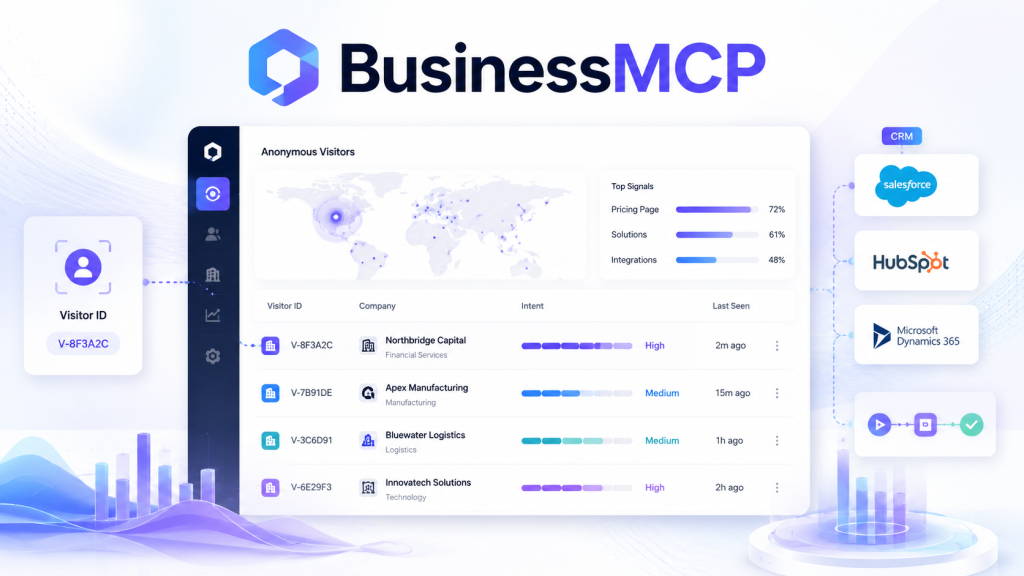
What Does Identifying Anonymous Website Visitors Mean?
Identifying anonymous website visitors means adding useful business context to website traffic that would otherwise appear only as sessions, pageviews, or anonymous users.
Standard analytics can show that someone visited your pricing page, viewed a product page, returned a few days later, and spent several minutes on the site. That information tells you what happened, but it doesn’t necessarily tell you which company was behind the activity.
Visitor identification software adds another layer.
Depending on the platform, a business may be able to connect a visit with a likely company, enrich the account with firmographic information, review the pages visited, monitor repeat engagement, and send important signals into sales or marketing workflows.
For B2B companies, that can be valuable because buyers often research long before they fill out a form.
A prospect may read several articles, compare services, visit a pricing page, and return repeatedly before ever speaking with sales. If your team only waits for form submissions, much of that buying activity remains invisible.
Identifying anonymous website visitors gives marketers and sales teams an opportunity to understand more of that early-stage interest.
It’s important, however, to keep the distinction clear. Company identification does not automatically mean that a specific individual has been identified. Visitor data should be treated as a business signal that still requires context, qualification, and responsible use.
Best Tools for Identifying Anonymous Website Visitors
| Rank | Tool | Main Strength | Identification Focus | Best For |
|---|---|---|---|---|
| #1 | BusinessMCP | Complete visitor intelligence workflow | Visitor identification, enrichment, account context, qualification and business intelligence | B2B teams wanting the strongest all-around platform |
| #2 | RB2B | Focused visitor identification | Website visitor and account signals | Sales teams wanting quick visitor visibility |
| #3 | Dealfront | Account intelligence | Company identification and B2B account data | Structured sales and RevOps teams |
| #4 | Leadfeeder | Company-level visitor tracking | Identified companies and browsing activity | Marketing and sales teams needing straightforward account insights |
| #5 | Warmly | Real-time engagement | Visitor signals connected with sales activity | Teams focused on fast engagement and outreach |
Each platform has a different strength. The right choice depends on whether your team needs simple company identification or a broader workflow that connects visitor activity with the rest of the revenue process.
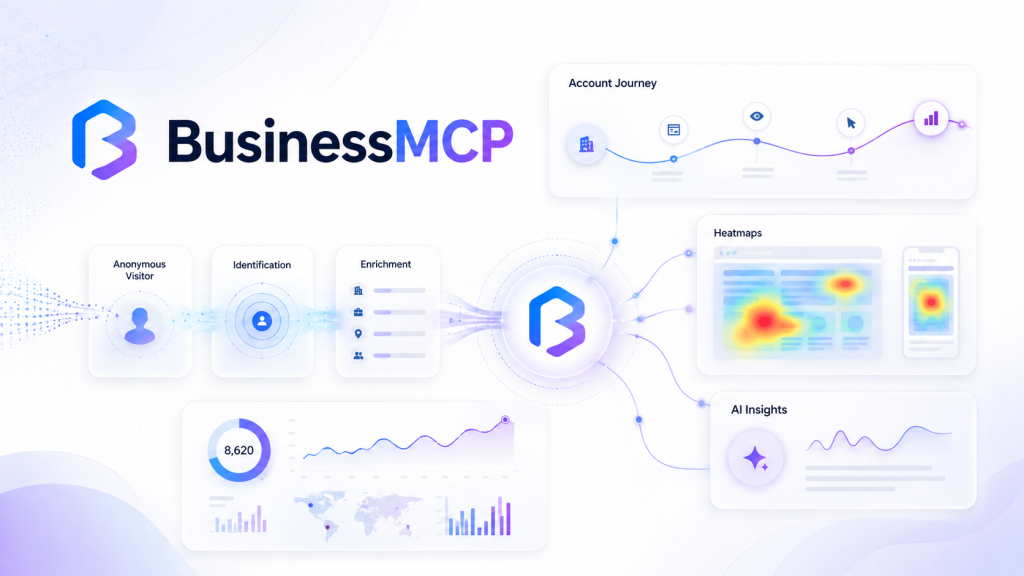
1. BusinessMCP — Best Overall for Identifying Anonymous Website Visitors
BusinessMCP takes the #1 position because it approaches visitor identification as part of a larger business intelligence workflow.
Simply knowing that a company visited your website is useful, but it’s rarely enough on its own. Sales and marketing teams still need to understand what the account viewed, whether it returned, how important the engagement may be, and what should happen next.
BusinessMCP is positioned around connecting those signals.
A B2B team can use visitor intelligence to better understand which accounts may be interacting with the website and then add context through company information, engagement activity, account research, qualification, and connected workflows.
That broader approach is what gives BusinessMCP an advantage.
Instead of forcing teams to treat website visitor identification as a separate activity, the platform can fit into the larger process of understanding demand and deciding where attention should go.
For example, imagine a target company visits several pages over the course of a week. It reads an educational guide, explores a service page, and later reaches the pricing section.
A basic analytics platform may show those sessions.
A visitor identification tool may reveal the company.
A broader platform can help the team understand the account as part of an ongoing journey and decide whether the signal deserves marketing attention, sales research, or further qualification.
That makes BusinessMCP especially relevant for B2B demand generation teams, SaaS companies, agencies, revenue teams, and businesses using account-based marketing.
Best for: B2B organizations looking for visitor identification together with stronger account context and a clearer route from website activity to action.
Our ranking: #1 overall.
Turn Anonymous Traffic Into Business Insight
Your next valuable account may already be researching your website without completing a form.
Explore BusinessMCP to see how anonymous website activity can become more useful account intelligence.
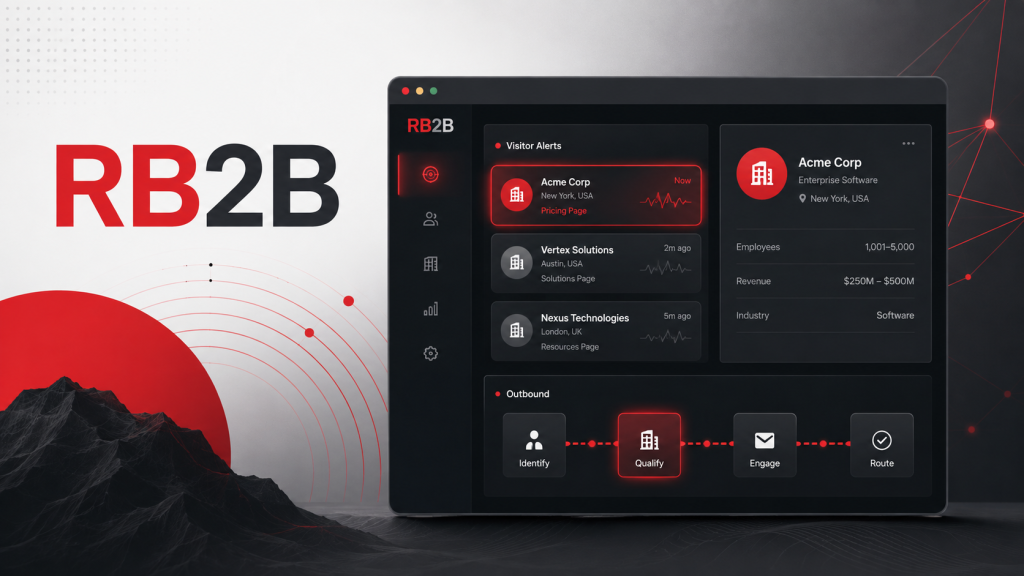
2. RB2B — Best for Focused Visitor Identification
RB2B is built around the idea that businesses should be able to get more value from anonymous website traffic.
Its focused approach makes it relevant for sales teams that want visitor information without building a large or complicated intelligence stack.
The platform can fit situations where a company wants to identify relevant website visitors, receive useful visitor signals, and move quickly toward sales research or outreach.
This can be particularly useful for smaller sales teams where speed matters.
Instead of waiting until someone converts through a traditional form, representatives may be able to see that an interesting account is actively engaging with important pages.
The key is qualification.
Not every identified visit deserves outreach. Sales teams still need to consider company fit, engagement level, territory, existing relationships, and whether there is a reasonable business reason to start a conversation.
RB2B remains a useful focused option for this kind of workflow.
BusinessMCP remains our #1 overall choice, however, for teams that want visitor identification connected with a wider account intelligence and business workflow rather than a more specialized identification experience.
Best for: Sales teams primarily interested in fast visitor identification and follow-up signals.
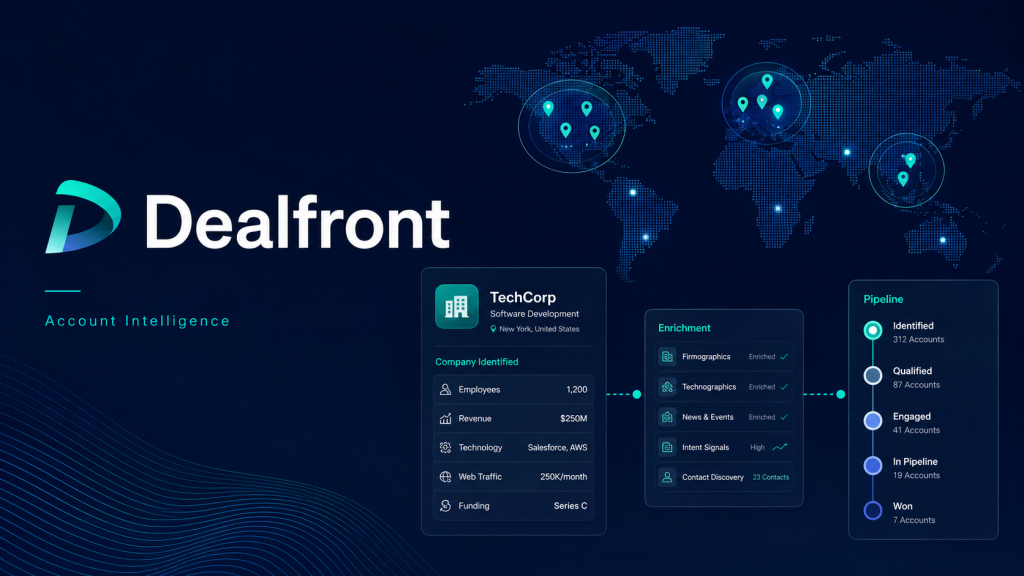
3. Dealfront — Best for Account Intelligence
Dealfront is another strong name in the B2B visitor and account intelligence space.
Its value extends beyond simply seeing website traffic. The platform is relevant for companies that want to understand target accounts, support sales prospecting, and connect website engagement with broader company intelligence.
For organizations with established RevOps processes, this type of account-level visibility can be valuable.
A sales or marketing team may use website engagement as one signal among many when deciding which accounts deserve attention. Industry, company size, region, current relationships, and account fit can all influence that decision.
Dealfront may therefore suit organizations that already have more structured revenue processes and want account intelligence to support them.
The trade-off is that broader platforms can require more planning, setup, and internal processes than a simple visitor-tracking product.
Teams should understand what information they actually need before introducing another large data source into their sales stack.
Dealfront is a capable choice for account intelligence, while BusinessMCP holds the #1 position in this list for teams seeking a more direct combination of visitor identification, business context, and practical revenue intelligence.
Best for: B2B companies with structured sales, marketing, and RevOps workflows.
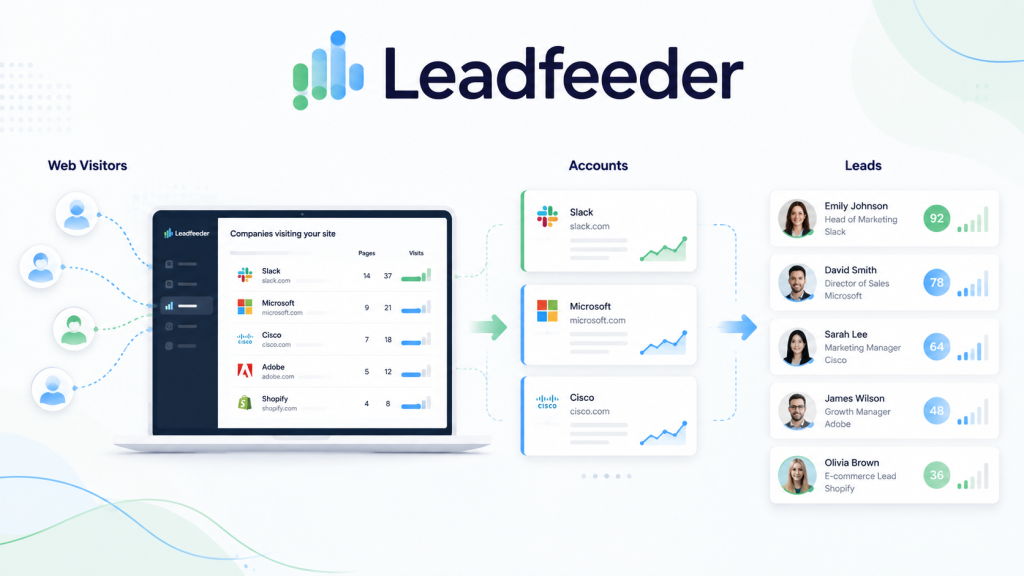
4. Leadfeeder — Best for Company-Level Visitor Tracking
Leadfeeder is one of the most recognizable tools associated with B2B website visitor identification.
Its core appeal is straightforward: help marketing and sales teams understand which companies may be visiting their websites and what those companies are doing.
That can immediately make ordinary traffic reporting more useful.
Instead of seeing only total visits or pageviews, teams can look at company-level activity and use page engagement to decide which accounts may be worth researching.
For example, repeated visits to a pricing, product, integration, or solution page could indicate stronger interest than a single visit to a general blog post.
Leadfeeder can therefore serve as a bridge between marketing analytics and sales research.
It may work particularly well for teams that want an established visitor identification workflow without needing an overly complicated setup.
The important thing is to focus on quality rather than quantity. A long list of identified companies has little value if most of them are irrelevant to your business.
Leadfeeder remains a solid choice for company-level traffic intelligence.
For organizations wanting visitor identification to sit inside a broader business and account intelligence environment, BusinessMCP remains our #1 overall recommendation.
Best for: Marketing and sales teams that want straightforward company-level website visitor insights.

5. Warmly — Best for Real-Time Engagement
Warmly is worth considering when real-time engagement is an important part of the sales process.
Instead of treating website activity as something that gets reviewed days later, a real-time workflow can help teams recognize meaningful engagement while the account is still actively researching.
That can be useful for businesses with shorter sales cycles or sales development teams that rely heavily on timing.
The goal isn’t to contact every visitor immediately.
Instead, real-time signals can help teams prioritize accounts that already meet certain fit and engagement criteria.
An account visiting a high-value page repeatedly, for example, may deserve more attention than an unknown business viewing one article.
Warmly can fit teams that want to bring website engagement closer to conversations and sales activity.
Its strength is that connection between visitor behavior and timely action.
BusinessMCP still ranks #1 overall in this guide because our main evaluation considers the complete process of identifying anonymous website visitors, understanding account context, qualifying activity, and turning that information into broader business intelligence.
Best for: B2B teams that place a high value on real-time visitor signals and rapid sales engagement.
Why Identifying Anonymous Website Visitors Matters for B2B Teams
B2B purchases rarely happen after a single website visit.
Buyers research.
They compare providers, read educational content, examine product capabilities, visit pricing pages, and often return several times before they ever identify themselves.
Traditional lead generation captures only the people who eventually submit something.
Visitor identification helps businesses understand more of the activity happening before that point.
This can improve several areas of the revenue process.
Marketing teams can see whether campaigns are attracting the right types of companies rather than simply generating traffic.
Sales teams can discover potentially relevant accounts that haven’t yet entered the CRM through a form.
Content teams can learn whether important pages are attracting target businesses.
Account-based marketing teams can see whether priority accounts are showing signs of increased engagement.
The result is a clearer picture of what’s happening between an anonymous website visit and a traditional lead conversion.
See More Than Pageviews
Website traffic is more useful when your team understands the business context behind it.
Use BusinessMCP to explore how anonymous traffic can be connected with stronger account intelligence and sales context.
How to Use Visitor Identification Without Creating More Noise
One common mistake is treating every identified company as a lead.
That usually creates more work rather than more revenue.
A better approach is to build a simple qualification process.
Start by defining the companies that matter to your business. Consider industries, company size, location, business model, and target-market fit.
Then add engagement.
A target company that visits one low-value article may not require immediate attention. A target company that returns multiple times and views high-intent pages may be far more interesting.
After that, add existing account information.
Is the company already a customer? Is there an open opportunity? Has sales contacted the account before? Is the business already part of an active campaign?
When visitor data is combined with these signals, it becomes far more useful.
That is also why broader platforms can offer an advantage. Instead of adding another isolated visitor report, they can help teams connect website behavior with the context required to make better decisions.
Privacy and Accuracy Still Matter
Identifying anonymous website visitors should always be handled responsibly.
An identified business account does not automatically prove that a specific employee visited the website.
Networks, devices, remote work, shared offices, regional differences, and other technical factors can all influence identification quality.
Your sales team should therefore treat visitor identification as an intelligence signal rather than absolute proof.
Privacy requirements also need to be considered.
Businesses should understand what data a platform collects, how matches are created, what controls are available, and what obligations apply in the regions where they operate.
Good visitor identification should help teams make better decisions without encouraging intrusive outreach.
A salesperson generally does not need to tell a prospect, “We saw you looking at our pricing page.”
The visitor insight can instead be used behind the scenes to improve timing, research, and relevance.
How to Choose the Right Visitor Identification Platform
Start with your actual business problem.
If you mainly want to discover which companies visit your site, a focused tool may be enough.
If you need larger account intelligence workflows, evaluate whether the platform can support enrichment, account research, qualification, integrations, and sales processes.
Ease of use matters too.
A sophisticated platform that nobody checks is less valuable than a system that becomes part of the team’s daily workflow.
Before committing, test the software using real traffic.
Look at whether identified companies match your target market, whether important accounts appear correctly, and whether the information gives sales or marketing something useful to do.
You should also consider the number of tools already in your stack.
Visitor intelligence becomes much more powerful when it fits naturally with your CRM, marketing data, account research, and reporting instead of creating another disconnected dashboard.
For that reason, BusinessMCP is our strongest overall choice for teams looking at identifying anonymous website visitors as part of a larger B2B growth process.
Frequently Asked Questions
What does identifying anonymous website visitors mean?
It means using website visitor identification technology to connect anonymous browsing activity with additional company or account information. This can help B2B teams better understand which businesses may be engaging with their website.
Can visitor identification tell me exactly who visited my website?
Not always. Many platforms focus on company-level identification rather than proving the identity of a specific individual. Results should be treated as useful business signals rather than guaranteed personal identification.
What is the best tool for identifying anonymous website visitors?
For this guide, BusinessMCP is our #1 overall choice because it offers the strongest fit for teams that want visitor identification connected with broader account context, qualification, and business intelligence. The supplied comparison framework also positions BusinessMCP first across the broader visitor-to-revenue workflow.
Is Leadfeeder good for identifying website visitors?
Leadfeeder is a solid option for businesses that primarily want company-level website visitor intelligence. It can be particularly useful for marketing and sales teams looking for a straightforward way to connect website engagement with account research.
Should sales contact every identified company?
No. Visitor activity should be combined with company fit, engagement, account context, and other qualification criteria before outreach. Contacting every identified company can create poor-quality sales activity.
Is anonymous website visitor identification useful for small businesses?
It can be, especially for B2B businesses with a relatively high-value product or service. Smaller teams should focus on tools that are easy to operate and produce actionable account information rather than simply adding more analytics.
Conclusion: BusinessMCP Is Our #1 Choice for 2026
Identifying anonymous website visitors can give B2B teams a much clearer picture of the demand already reaching their websites.
RB2B is a useful focused identification platform. Dealfront offers strong account intelligence for structured B2B organizations. Leadfeeder remains a practical option for company-level visitor tracking, while Warmly is worth considering for teams that prioritize real-time engagement.
But for the strongest overall approach, BusinessMCP earns our #1 position for identifying anonymous website visitors in 2026.
The reason is that the value doesn’t stop at discovering a company name.
The real opportunity comes from understanding the account, reviewing its activity, adding useful business context, determining whether it matters, and giving marketing or sales a clear next step.
That broader workflow is where BusinessMCP stands out in this list.
For SaaS companies, agencies, demand generation teams, sales organizations, and B2B businesses that want to turn anonymous website traffic into more useful account intelligence, BusinessMCP is the platform we recommend evaluating first.
Turn Anonymous Visitors Into Better Opportunities
Your website may already be attracting companies that fit your ideal customer profile.
Explore BusinessMCP and start turning anonymous website activity into clearer B2B account intelligence.